New Linux 'Dirty Frag' zero-day gives root on all major distros
A new Linux zero-day vulnerability, named Dirty Frag, allows local attackers to gain root privileges on most major Linux distributions with a single command.
Aggregated from BleepingComputer
This article was automatically aggregated from an external source. Content may be summarized.
Full Analysis
A new Linux zero-day vulnerability, named Dirty Frag, allows local attackers to gain root privileges on most major Linux distributions with a single command.
Security researcher Hyunwoo Kim, who disclosed the flaw earlier today and published a proof-of-concept (PoC) exploit, says this privilege escalation flaw was introduced roughly nine years ago in the Linux kernel's algif_aead cryptographic algorithm interface.
Dirty Frag works by chaining two separate kernel flaws, the xfrm-ESP Page-Cache Write vulnerability and the RxRPC Page-Cache Write vulnerability, to modify protected system files in memory without authorization and achieve privilege escalation.
Also, while Dirty Frag belongs to the same class as the Dirty Pipe and Copy Fail Linux vulnerabilities, it exploits the fragment field of a different kernel data structure.
The vulnerability has yet to receive a CVE-ID for tracking and affects a wide range of Linux distros, including Ubuntu, Red Hat Enterprise Linux, CentOS Stream, AlmaLinux, openSUSE Tumbleweed, and Fedora, which have not yet received patches.
"Because it is a deterministic logic bug that does not depend on a timing window, no race condition is required, the kernel does not panic when the exploit fails, and the success rate is very high," Kim said.
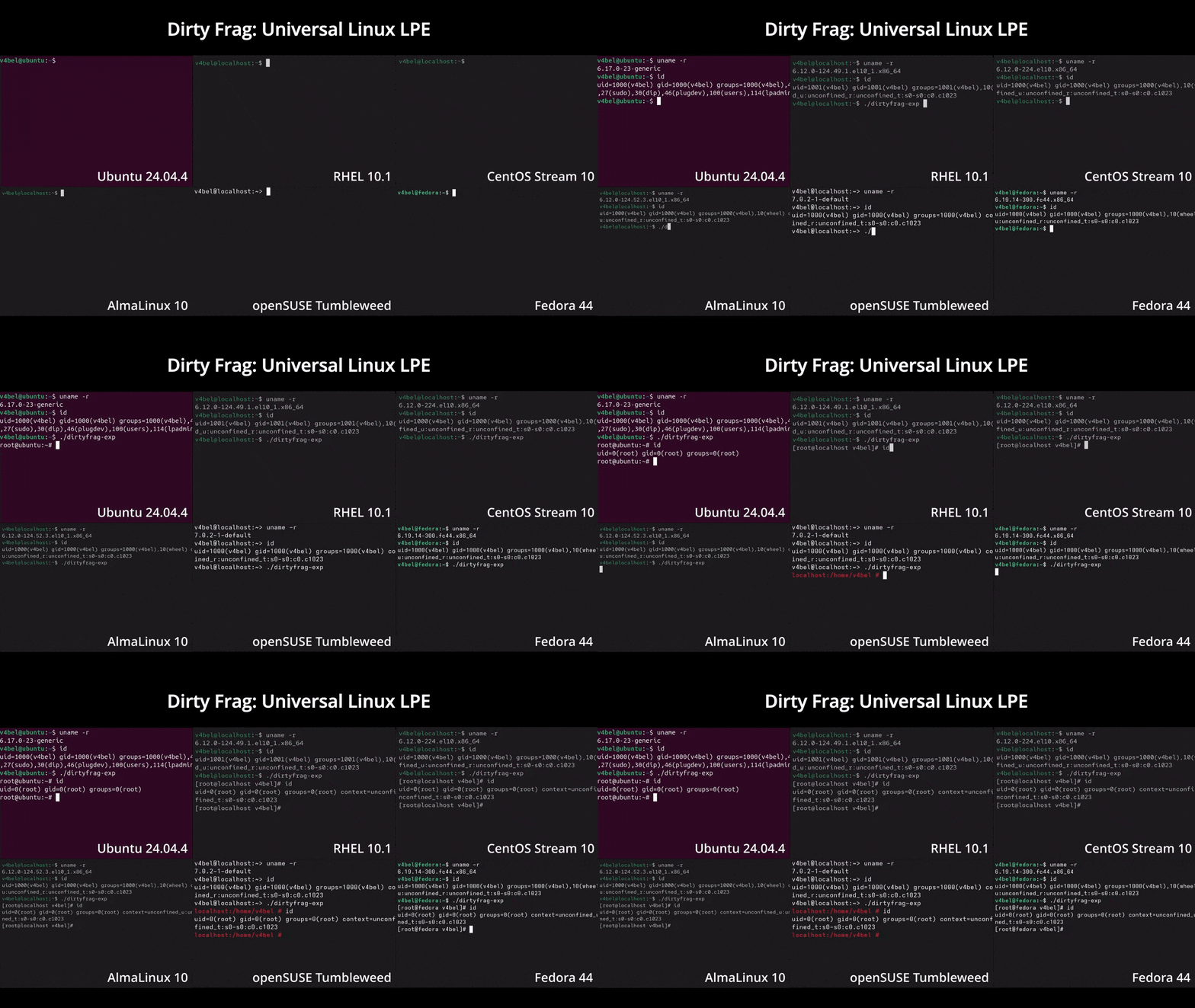
Kim released complete Dirty Frag documentation and a PoC exploit with distribution maintainers' agreement after an embargo on full public disclosure was broken on May 7, 2026, when an unrelated third party independently published the exploit.
"Because the embargo has currently been broken, no patch or CVE exists. After consultation with the maintainers on linux-distros@vs.openwall.org and at their request, this Dirty Frag document is being published," Kim said.
This new zero-day disclosure comes as Linux distro maintainers are still rolling out patches for "Copy Fail," another root privilege escalation vulnerability now actively exploited in attacks.
CISA added Copy Fail to its Known Exploited Vulnerabilities (KEV) Catalog last Friday, ordering federal agencies to secure their Linux devices within two weeks, by May 15.
"This type of vulnerability is a frequent attack vector for malicious cyber actors and poses significant risks to the federal enterprise," the U.S. cybersecurity agency warned at the time. "Apply mitigations per vendor instructions, follow applicable BOD 22-01 guidance for cloud services, or discontinue use of the product if mitigations are unavailable."
In April, Linux distros patched another root-privilege escalation vulnerability (dubbed Pack2TheRoot) that had been found after a decade since it was introduced in the PackageKit daemon.

99% of What Mythos Found Is Still Unpatched.
AI chained four zero-days into one exploit that bypassed both renderer and OS sandboxes. A wave of new exploits is coming.
At the Autonomous Validation Summit (May 12 & 14), see how autonomous, context-rich validation finds what's exploitable, proves controls hold, and closes the remediation loop.
Originally published by BleepingComputer
Original Source
BleepingComputer