CISA orders feds to patch DarkSword iOS flaws exploited attacks
CISA ordered U.S. government agencies to patch three iOS vulnerabilities targeted in cryptocurrency theft and cyberespionage attacks using the DarkSword exploit kit.

AI-Generated Summary
CISA has mandated U.S. federal agencies patch three actively exploited iOS vulnerabilities (CVE-2025-31277, CVE-2025-43510, CVE-2025-43520) tied to the DarkSword exploit kit, which chains six flaws to enable sandbox escape, privilege escalation, and remote code execution on iPhones running iOS 18.4–18.7. The exploit kit has been linked to threat groups UNC6748 and UNC6353, the latter a suspected Russian espionage actor deploying malware families GhostBlade, GhostKnife, and GhostSaber in watering-hole and cyberespionage campaigns. Federal agencies have a two-week remediation deadline under BOD 22-01, and CISA urges private sector organizations to also prioritize patching immediately.
Threat Actor
UNC6353 (suspected Russian espionage group), UNC6748 (PARS Defense customer)
Affected Sectors
Frameworks
Aggregated from BleepingComputer
This article was automatically aggregated from an external source. Content may be summarized.
Full Analysis

CISA ordered U.S. government agencies to patch three iOS vulnerabilities targeted in cryptocurrency theft and cyberespionage attacks using the DarkSword exploit kit.
As Google Threat Intelligence Group (GTIG) and iVerify researchers revealed last week, the DarkSword delivery framework abuses a chain of six vulnerabilities tracked as CVE-2025-31277, CVE-2025-43529, CVE-2026-20700, CVE-2025-14174, CVE-2025-43510, and CVE-2025-43520.
These flaws enable attackers to escape sandboxes, escalate privileges, and gain remote code execution on unpatched iPhones, but have all been patched by Apple in the latest iOS releases and now only affect iPhones running iOS 18.4 through 18.7.
DarkSword was also linked by security researchers to multiple threat groups, including UNC6748, a customer of Turkish commercial surveillance vendor PARS Defense, and a suspected Russian espionage group tracked as UNC6353.
In these attacks, GTIG observed three separate information-theft malware families dropped on victims' devices: a very aggressive JavaScript infostealer named GhostBlade, the GhostKnife backdoor that can exfiltrate large swaths of data, and the GhostSaber JavaScript that executes code and also steals victims' data.
Of the three, UNC6353 deployed both the DarkSword and Coruna iOS exploit kits in watering-hole attacks targeting iPhone users visiting compromised Ukrainian websites of e-commerce, industrial equipment, and local services organizations.
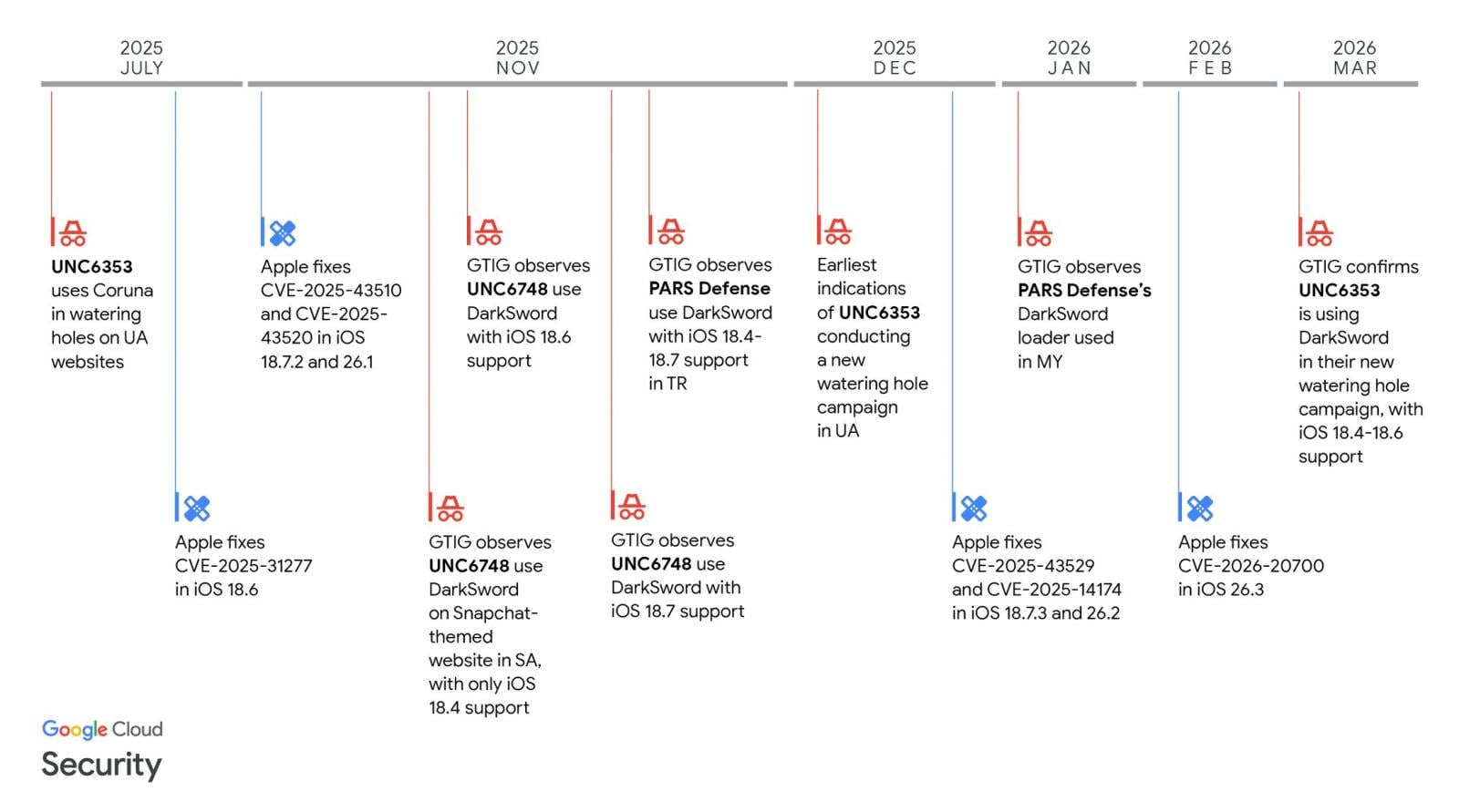
Notably, DarkSword wipes temporary files and exits after stealing data from infected devices, indicating that it was designed for short-term surveillance operations designed to evade detection.
Mobile security company Lookout, which discovered DarkSword while investigating infrastructure used in the Coruna attacks, believes that DarkSword is used in cyber-espionage campaigns aligned with Russian intelligence requirements and by a Russian threat actor with financial objectives.
On Friday, CISA added three of the 6 DarkSword vulnerabilities (CVE-2025-31277, CVE-2025-43510, and CVE-2025-43520) to its catalog of actively exploited security flaws, ordering Federal Civilian Executive Branch (FCEB) agencies to secure their devices within two weeks by April 3, as mandated by Binding Operational Directive (BOD) 22-01.
"Apply mitigations per vendor instructions, follow applicable BOD 22-01 guidance for cloud services, or discontinue use of the product if mitigations are unavailable," CISA warned.
"These types of vulnerabilities are frequent attack vectors for malicious cyber actors and pose significant risks to the federal enterprise."
Although BOD 22-01 applies only to federal agencies, CISA urged all defenders, including those working for private sector companies, to prioritize securing their organizations' devices against these flaws as soon as possible.

Red Report 2026: Why Ransomware Encryption Dropped 38%
Malware is getting smarter. The Red Report 2026 reveals how new threats use math to detect sandboxes and hide in plain sight.
Download our analysis of 1.1 million malicious samples to uncover the top 10 techniques and see if your security stack is blinded.
Originally published by BleepingComputer
Original Source
BleepingComputer